
- About
- Serverless Postgres for modern developers. Open-source alternative to Amazon Aurora Serverless.
- Catalogue
- No. 046
- Category
- Data & Content
- Founded
- 2021, San Francisco, USA
- GitHub stars
- ★ 23.2k
Overview
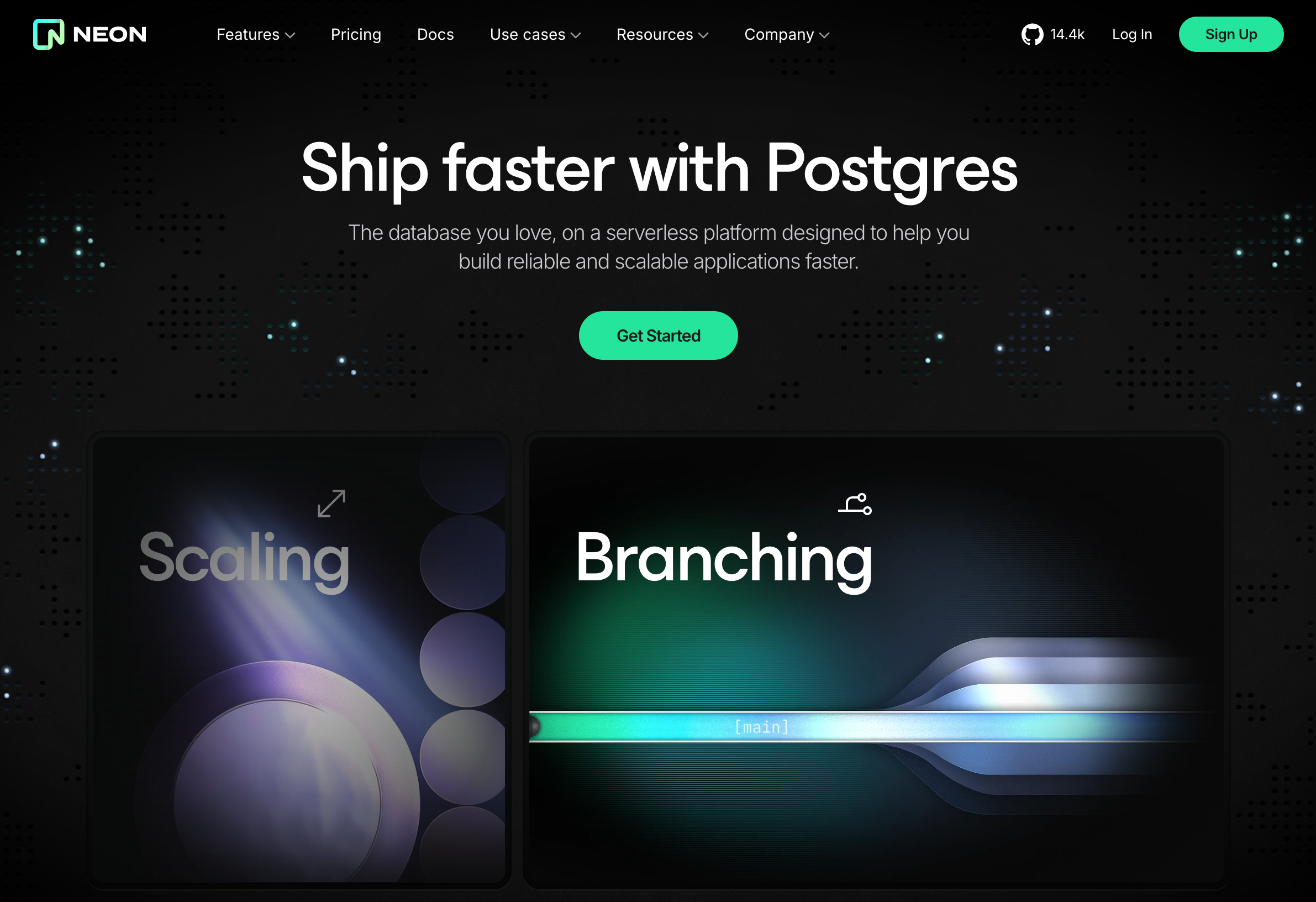
Neon is a fully managed serverless Postgres with a generous free tier. It separates storage and compute to offer autoscaling, branching, and bottomless storage. Neon provides developers with a modern, developer-friendly database that combines the reliability of Postgres with the flexibility of serverless architecture, enabling effortless scaling and optimized resource utilization.
What it does well
Neon offers instant scalability, allowing databases to grow without limits and scale to zero when inactive. Its unique branching feature enables developers to create instant database copies for development, testing, and staging environments. With bottomless storage, users never run out of space, and the pay-per-use model ensures cost-efficiency. Neon's serverless architecture eliminates the need for database administration, letting developers focus on building applications.
Why it’s in the collection
Neon stands out for bringing true serverless capabilities to Postgres, one of the most popular and powerful relational databases. Its innovative approach to separating storage and compute solves many traditional database scaling challenges. The branching feature is a game-changer for development workflows, allowing instant, cost-effective database cloning. By combining the familiarity of Postgres with modern cloud-native features, Neon makes it easier for developers to build scalable applications without compromising on database functionality or performance.
On GitHub
- Stars
- 23,199
- Forks
- 1,113
- Commits
- 8,475
- Repository
- neondatabase/neon
Languages
- Rust 74%
- C 5.8%
- Python 19.4%
- Other 0.8%
Compared with
 Amazon Aurora ServerlessAWS's serverless relational database, but tied to the AWS ecosystem and potentially more complex to use.
 Google Cloud SpannerFully managed relational database with high scalability, but can be expensive and has a steeper learning curve.
 CockroachDB ServerlessDistributed SQL database with a serverless tier, but may have limitations compared to traditional Postgres.