T3 Codevs Codex app
- About
- Both are desktop apps where coding agents work in parallel threads, with Git worktrees and diff review built in. The Codex app is OpenAI’s own, built around its Codex agent. T3 Code is open source and controls many agents, including Codex and Claude Code, so you can switch models in the middle of a thread.
- Comparing
- Open source vs closed source
- T3 Code
- ★ 79.2k
- Page updated
At a glance
From GitHub and Codex app’s own site T3 CodeNo. 093 |  Codex app | |
|---|---|---|
| What it is | Open-source control panel for the coding agents on your machine | OpenAI’s desktop app for running Codex agents in parallel threads |
| Best for | a control panel for the coding agents on your machine | people who work with OpenAI’s models and want them in one app |
| Source code | Open source: MIT | Closed source |
| Made by | Its maintainers on GitHub (pingdotgg/t3code) | OpenAI |
| Run it on your own servers | Yes | It runs on your computer, on macOS and Windows. The app’s source code isn’t public |
| GitHub stars | ★ 79.2k (+49k in 30 days) | Not on GitHub |
| Last commit | — | |
| Pricing | Its page on Prosper | Official pricing page |
Which to choose
Choose T3 Code if…
Choose T3 Code if you use more than one agent, such as Claude Code and Codex. It also fits if you want open-source code and a phone app for your threads.
Downsides: It drives agents you’ve already installed and signed in to, so it doesn’t replace them. The MIT license covers the code only, so a fork has to use its own name and branding.
Choose Codex app if…
Choose Codex app if you work only with OpenAI’s models and want the app from the company that makes them.
Downsides: It’s built around OpenAI’s Codex agent, and its source code isn’t public.
T3 Code in the collection
Whole collection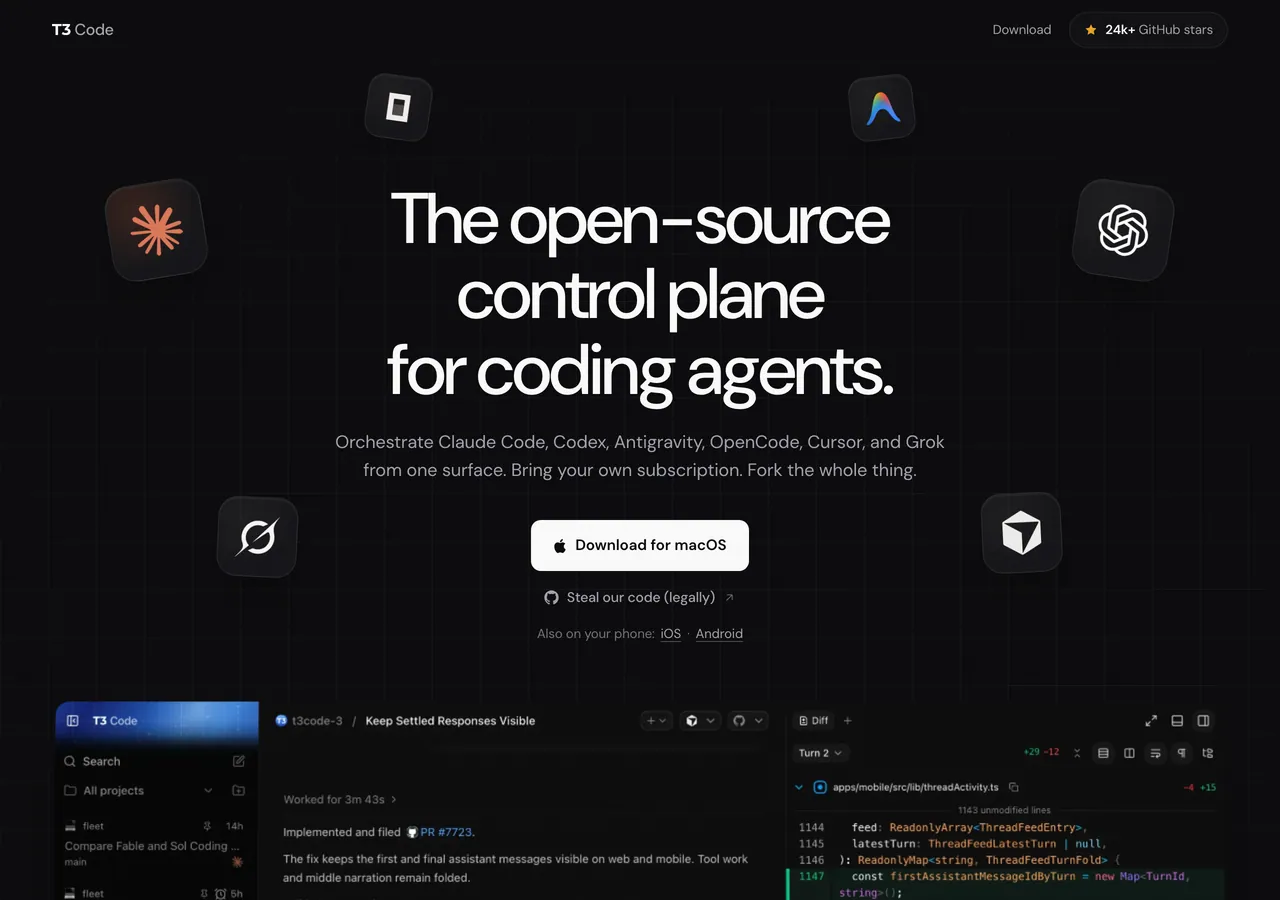
Considering others too? See all open-source coding agent apps.