
- About
- High-performance runtime for multi-agent systems.
- Catalogue
- No. 069
- Category
- Development
- Founded
- 2024, Open Source
- GitHub stars
- ★ 42.7k
Overview
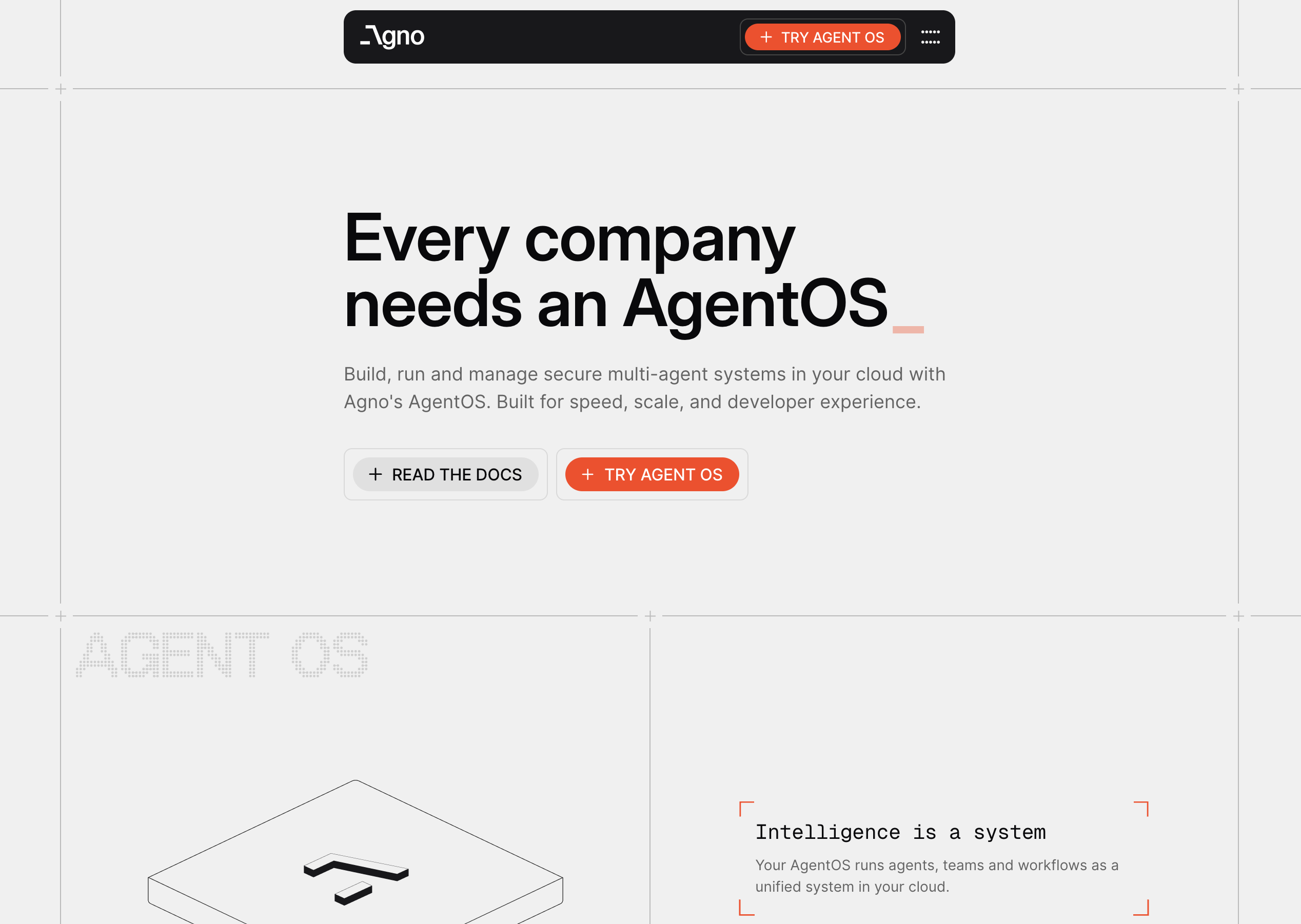
Agno is a high-performance runtime designed specifically for building, running, and managing secure multi-agent systems. It provides a minimal, open-source setup for serving AI agents using FastAPI and Postgres, built with a focus on speed, clarity, and developer happiness. Agno enables developers to deploy production-ready multi-agent systems in their own cloud infrastructure with full control and transparency.
What it does well
Agno offers exceptional performance for multi-agent systems with a clean, developer-friendly architecture. It provides secure agent deployment in your own cloud infrastructure, giving you full control over your AI systems. The platform includes built-in support for agent orchestration, state management, and inter-agent communication, making it easy to build complex multi-agent workflows. With its FastAPI foundation, Agno delivers modern async-first architecture and seamless integration with popular AI frameworks.
Why it’s in the collection
Agno is ideal for developers building sophisticated AI agent systems who need high performance and security. Its minimal design philosophy means less complexity and faster development cycles. The open-source nature allows for complete customization while the FastAPI foundation ensures modern, async-first architecture. Perfect for teams that want to deploy production-ready multi-agent systems without vendor lock-in. Whether you're building autonomous agents, multi-agent workflows, or complex AI orchestration systems, Agno provides the performance and flexibility you need.
On GitHub
- Stars
- 42,731
- Forks
- 6,135
- Commits
- 6,196
- Repository
- agno-agi/agno
Languages
- Python 99.5%
- Other 0.5%
Compared with
 LangGraphGraph-based agent orchestration framework, but with more complexity and overhead for simple multi-agent systems.
 AutoGenMicrosoft's multi-agent conversation framework, but less focused on production deployment and performance.
 CrewAIRole-based multi-agent framework, but with more opinionated structure and less flexibility.